
When I’m on the shop floor, PEEK is always the star. It is a powerhouse material, but clients often ask about the density of PEEK before starting a project.
Density is vital for calculating a part’s weight-to-strength ratio. In high-stakes industries like aerospace, knowing this value ensures your components are lightweight yet durable enough to perform under pressure.
What is PEEK?
Polyetheretherketone, or PEEK, is a semi-crystalline thermoplastic. In our world, it’s known for being incredibly tough. It handles high temperatures, resists harsh chemicals, and maintains its shape under heavy loads.
In engineering, density isn’t just a number on a datasheet. It dictates the weight-to-strength ratio. If you are designing a drone or a medical implant, every gram counts. If you know the density, you can calculate your part’s weight before we even load the stock material into the CNC machine.
Standard Density Values

Not all PEEK is created equal. Depending on the application, we often use PEEK mixed with other materials to enhance its properties.
Unfilled PEEK
This is often called “Virgin PEEK.” It’s the purest form and offers the best chemical resistance and biocompatibility.
Density: 1.32 g/cm³
Best for: Medical tools, food processing components, and electrical insulators.
Glass-Filled PEEK (GF30)
When we add 30% glass fibers to the mix, we are looking to increase structural stiffness. However, glass is heavier than plastic.
Density: 1.49 to 1.52 g/cm³
Why use it? It reduces the thermal expansion rate, meaning the part stays more “true” to its size when things get hot.
Carbon-Filled PEEK (CF30)
This is the “special forces” of plastics. By adding 30% carbon fiber, we get a material that is stiffer and even better at shedding heat. Interestingly, carbon fiber is lighter than glass fiber.
Density: 1.40 to 1.44 g/cm³
Why use it? It offers the highest strength-to-weight ratio available in the PEEK family.
Bearing Grade PEEK
Sometimes we use PEEK for moving parts like bushings or bearings. To reduce friction, we add PTFE (Teflon), graphite, and carbon fiber. Because PTFE is quite dense, the overall density of this grade usually sits around 1.44 to 1.48 g/cm³.
Factors Influencing Density
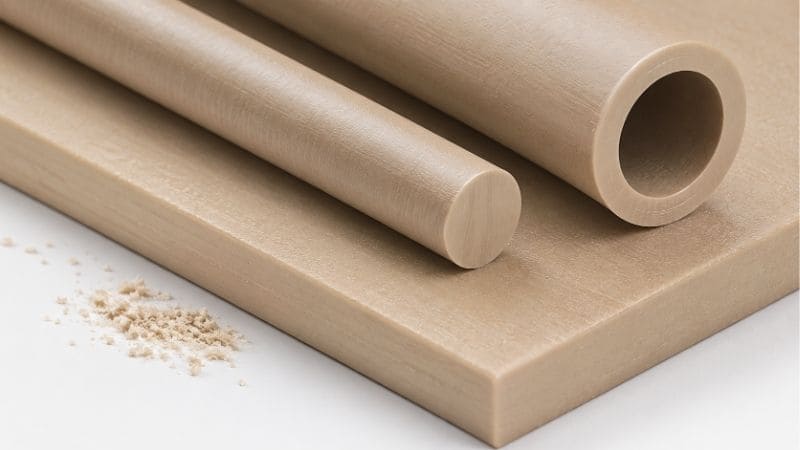
You might think density is a fixed physical constant, but in the world of high-end manufacturing, there are variables that can cause slight shifts.
Crystallinity Levels
PEEK is “semi-crystalline.” Think of it like a bowl of spaghetti where some parts are neatly folded (crystalline), and others are a tangled mess (amorphous).
- Crystalline areas are packed tighter, making them denser.
- Amorphous areas are less packed and slightly less dense.
In CNC machining, how we cool the material during the manufacturing of the raw rod or plate matters. If it cools too fast, it becomes more amorphous. If it cools slowly, it becomes more crystalline. As an engineer, I prefer a higher crystalline state because it makes the material more stable and wear-resistant.
Environmental Effects
While PEEK is famous for its stability, physics still applies.
- Temperature: As PEEK gets hot, it expands. As it expands, its density slightly decreases. However, compared to other plastics, PEEK is very “dimensionally stable,” meaning it doesn’t change much.
- Moisture: Some plastics, like Nylon, soak up water like a sponge, which changes their weight and size. PEEK is different. It has a moisture absorption rate of nearly zero. This means its density stays consistent even in underwater applications.
Why Density Matters in CNC Machining

When a client sends me a CAD file, the first thing I look at is the volume of the part. Understanding density allows us to solve several practical problems.
Calculating Part Weight
Before we start cutting, we need to know the final weight. This is especially true for the aerospace industry. If a part is too heavy, the plane burns more fuel.
We use a simple formula:
Mass = Volume × Density
By using the precise density of the specific PEEK grade (like 1.32 g/cm³ for virgin PEEK), we can tell the client exactly what the shipping weight will be.
Shipping and Logistics
I’ve seen projects where we replaced stainless steel parts with PEEK. Because PEEK’s density is so much lower (1.32 g/cm³ vs 8.0 g/cm³), the shipping costs dropped by 80%. For large production runs of thousands of parts, those savings are massive.
Tooling and Feeds
Density tells me how “compact” the molecules are. Higher density often means I need to adjust my feed rates on the CNC machine. While PEEK is a dream to machine because it doesn’t chip easily, we have to be careful about heat. Because it is a dense plastic, heat doesn’t escape as fast as it does in metal. If we go too fast, the material can “gum up” or deform.
PEEK vs. Other Materials

To really understand PEEK’s density, you have to see how it stacks up against the competition.
PEEK vs. Other Plastics
PEEK (1.32 g/cm³): The middle ground. High strength, moderate weight.
PTFE / Teflon (2.1 to 2.3 g/cm³): Much heavier and much softer.
POM / Delrin (1.41 g/cm³): Slightly denser than PEEK but can’t handle the heat.
Ultem / PEI (1.27 g/cm³): Slightly lighter than PEEK, but not as strong in chemical environments.
PEEK vs. Metals
This is where PEEK really shines.
Aluminum (2.70 g/cm³): Twice as heavy as PEEK.
Titanium (4.50 g/cm³): Three times as heavy as PEEK.
Stainless Steel (8.00 g/cm³): Six times as heavy as PEEK.
When we talk about “lightweighting” in engineering, PEEK is the king. If a part doesn’t need the extreme hardness of steel, switching to PEEK can drastically reduce the weight without sacrificing much strength.
Common Industrial Applications

Because of its unique density and strength, we machine PEEK for some of the most demanding industries in the world.
Aerospace Components
In aircraft, weight is money. We use PEEK for cable brackets, pump gear parts, and valve seats. By choosing a material with a density of 1.32 g/cm³ instead of steel, we help engineers reduce the “dry weight” of the aircraft, leading to better fuel efficiency.
Medical Implants
This is a fascinating use case. The density of PEEK is very close to the density of human cortical bone. This is important for spinal cages and bone implants. If an implant is too “dense” or “stiff” (like titanium), it can actually damage the surrounding bone. PEEK’s density and modulus of elasticity make it feel “natural” to the body.
Subsea Oil & Gas
When you are lowering equipment 5,000 feet under the ocean, buoyancy matters. Heavy metal parts are hard to manage. PEEK components are easier to handle underwater because their lower density makes them more “neutral” in the water column, all while resisting the corrosive salt and high pressure.
Conclusion
Understanding the density of PEEK is the foundation of smart part design. Whether you need the purity of Virgin PEEK or the added stiffness of glass-filled grades, these values ensure your project meets its weight and performance targets.
At MedCNCParts, we combine technical expertise with precision CNC machining to bring your designs to life. Contact us today for a material consultation or a fast quote on your next PEEK project.


