
When I’m looking at a new project blueprint, one of the first things I check is the material spec. If it says Nylon, I know I’m working with one of the most versatile plastics in the shop. But “Nylon” is a broad term. To get the part right, especially when weight, cost, and fit are on the line, we have to talk about density.
Density isn’t just a number in a data sheet; it’s the DNA of the material. It tells us how the part will feel, how it will react to moisture, and how it will behave under a cutting tool. In this guide, I’ll break down everything you need to know about the density of Nylon from a practical, hands-on perspective.
What is Nylon?
Nylon, known technically as Polyamide (PA), is a high-performance engineering thermoplastic. We use it for everything from gears and bushings to manifolds and structural frames. It’s tough, it handles friction well, and it’s relatively easy to machine.
But why does density matter so much? In CNC machining, density is the bridge between your CAD model and the physical world. If I know the density, I can calculate exactly how much the final part will weigh before I even load a block of material onto the mill.
It helps me estimate shipping costs for high-volume runs and, more importantly, it helps me spot-check the material quality. If the density is off, something is wrong with the material.
Standard Density of Nylon
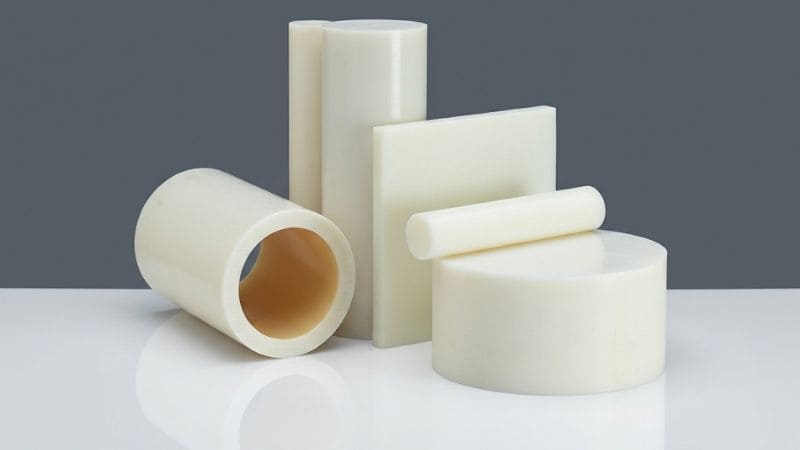
In general, Nylon is a lightweight material. If you look at the broad spectrum of Polyamides, the density usually falls between 1.01 to 1.15 g/cm³.
To put that into perspective, let’s compare it to the metals we often machine:
Aluminum (6061): ~2.70 g/cm³
Steel (Mild): ~7.85 g/cm³
Nylon is roughly one-third the weight of aluminum and one-seventh the weight of steel. This is why it’s the go-to choice for “lightweighting” in the automotive and aerospace sectors. If you can swap a metal bracket for a Nylon one without sacrificing too much strength, you immediately save a significant amount of energy or fuel for the end-user.
Density Across Different Grades

Not all nylons are created equal. The molecular structure changes depending on how the plastic is made, which shifts the density slightly.
Nylon 6
Nylon 6 is very common because it’s easy to process and has a great surface finish. Its density typically sits between 1.13 and 1.15 g/cm³. It’s a bit more ductile than other grades, making it great for parts that need to absorb impact.
Nylon 6/6
This is the “workhorse” of the CNC world. Nylon 6/6 is slightly harder and more heat-resistant than Nylon 6. Its density is usually almost exactly 1.14 g/cm³. When I’m quoting a job for high-wear industrial parts, this is usually what I’m looking at.
Nylon 11 Nylon 12
These are interesting because they are “low-moisture” nylons. They are less dense, ranging from 1.01 to 1.04 g/cm³. Because they are less dense, they actually float more easily and are incredibly stable in wet environments. They are the “lightweights” of the nylon family.
Specialty (Filled) Grades
This is where the numbers jump. If we add 30% Glass Fiber to Nylon 6/6 to make it stiffer, the density climbs to about 1.35 to 1.40 g/cm³. If we use Carbon Fiber, the density might stay lower, but the strength-to-weight ratio goes through the roof.
Factors Affecting Nylon Density

One thing I’ve learned over the years is that the density on the datasheet isn’t always the density of the part on your desk. Several factors can change the “apparent” density of your material.
Moisture Absorption
Nylon is hygroscopic. This is a fancy way of saying it acts like a sponge. It pulls moisture out of the air. When Nylon absorbs water, it swells. This increases the volume and the mass. If you leave a finished part in a humid warehouse, its density might change slightly as it reaches “equilibrium.” This is why we sometimes have to “condition” parts in water before shipping them to ensure they stay the right size.
Additives and Fillers
We rarely use “virgin” nylon for heavy-duty industrial parts. We often add:
- Molybdenum Disulfide (MoS₂): This makes the Nylon “self-lubricating.” It’s slightly denser than standard nylon.
- Glass Beads: These increase compressive strength and change the density.
- Heat Stabilizers: These are used in small amounts but can slightly shift the chemical weight.
Manufacturing Process: Extruded vs. Cast

How the raw material is made matters.
- Extruded Nylon is pushed through a die. It’s generally very consistent but can have internal stresses.
- Cast Nylon is poured into a mold. Because it cures at lower pressure, it’s often more “relaxed” and can actually be slightly more dense and crystalline than extruded versions. For large, thick parts, I almost always prefer Cast Nylon because it has fewer internal voids (which would lower the density and ruin the part).
Why Density Matters in CNC Machining

In the shop, density isn’t just a physics concept; it’s a practical tool.
Weight-to-Strength Ratio
Customers come to us because they want the strength of metal without the weight. Understanding density allows me to tell a customer, “If we switch from aluminum to nylon 6/6, your assembly will weigh 60% less while still maintaining enough rigidity for this bushing.”
Part Accuracy and Tooling
Density affects how the material “pushes back” against the tool. A denser material like glass-filled nylon is more rigid, so I can use higher clamping forces without crushing the part. However, it’s also more abrasive.
Standard Nylon is less dense and “softer,” so if I clamp it too hard in the vise, it will deform. Once I release the vise, the part “springs back,” and suddenly the dimensions are wrong. I have to adjust my machining strategy based on that density and rigidity.
Thermal Expansion
Lower density plastics usually have a higher Coefficient of Thermal Expansion (CTE). Nylon expands more than steel when it gets hot. During the machining process, the friction of the tool creates heat. If I don’t account for the density and the way it holds heat, the part might expand while I’m cutting it. When it cools down, it’ll be undersized.
How to Calculate Nylon Density

Sometimes a client sends us a material that isn’t labeled, or we need to verify a batch. Calculating density is straightforward.
The Formula
The standard formula for density (ρ) is:
ρ = m / V
Where:
m = mass (weight)
V = volume
A Practical Example
Let’s say I have a machined block of Nylon 6/6.
Find the mass: I put it on a precision scale, and it weighs 114 grams.
Find the volume: The block is 10 cm × 5 cm × 2 cm = 100 cm³.
Calculate:
ρ = 114 g ÷ 100 cm³ = 1.14 g/cm³
Matches the datasheet perfectly!
Comparing Nylon to Other Plastics
When engineers are deciding on a material, they usually look at Nylon alongside a few other favorites. Here is how they stack up in terms of density:
| Material | Typical Density (g/cm3) | Why it matters |
| Nylon 6/6 | 1.14 | The baseline for tough, lightweight parts. |
| Delrin (POM) | 1.41 | Denser and stiffer; machines like a dream. |
| PEEK | 1.32 | High-end performance, very stable. |
| HDPE | 0.95 | It actually floats in water; very low density. |
| PTFE (Teflon) | 2.20 | Very heavy for a plastic; feels like a rock. |
Nylon vs. Delrin: This is a common debate. Delrin is denser and doesn’t absorb moisture like Nylon does. However, Nylon is often tougher and more resistant to abrasion. If weight is the absolute priority, Nylon wins.
Industry Applications

Where do we see these density calculations put to work?
Automotive: Intake manifolds. These are large parts. By using Nylon instead of cast aluminum, car manufacturers save several pounds per engine, which improves gas mileage.
Aerospace: Spacers and cable management. Every gram matters in a plane. Nylon’s low density makes it ideal for non-structural components that keep wires organized.
Industrial Machinery: Gears and rollers. Nylon gears are quieter than metal ones. Their lower density means they have less “rotational inertia”—they take less energy to start and stop moving.
Marine: While Nylon 6 isn’t great for water, Nylon 12 is used because its density and low absorption keep it stable in the ocean.
Conclusion
Understanding the density of Nylon is about more than just filling out a spreadsheet. It’s about knowing how the part will live in the real world. Whether you are trying to shave grams off a drone frame or ensuring a gear can handle the friction of a conveyor belt, the density of your Polyamide choice is the foundation.
At DEK, we don’t just “cut shapes.” We look at the material science behind every project. We know how Nylon 6/6 behaves differently from a 30% glass-filled grade, and we adjust our CNC speeds, feeds, and clamping to match.
Getting the material right is the first step toward a perfect part. If you’re unsure which grade of Nylon—or which density—is right for your next project, reach out to us.
Would you like me to help you choose the right Nylon grade for your specific project or provide a material comparison chart for your next CNC quote? Contact DEK now.


