
When creating and machining high-wear surgical instruments, one of the first decisions that always has to be made is the choice of material. The wrong choice can lead to galling and wear, and can also result in a lack of precision if not done correctly.
In this guide, we will discuss the differences between Nitronic 60 vs 17-4 PH Stainless, and how to choose between them for surgical-grade CNC-machined parts.
Why Material Choice Matters in Surgical Instruments
High-Wear Challenges in Surgical Environments
We found that using the wrong alloy for the moving parts caused the hinge to bind after just a couple of dozen uses. By switching to an appropriate alloy for the moving parts, we eliminated galling and achieved smoother hinge motion. This one simple change has greatly increased the reliability of repeated procedures.
Performance Lifespan
Choosing Nitronic 60 for the pivot allowed the clamp to perform smoothly even after numerous cycles. Furthermore, the use of 17-4PH stainless steel in the clamp’s structural components resulted in excellent strength and consistent dimensions. By combining these materials, we significantly improved the clamp assembly’s longevity and overall performance.
Tool Wear and Machining Difficulty
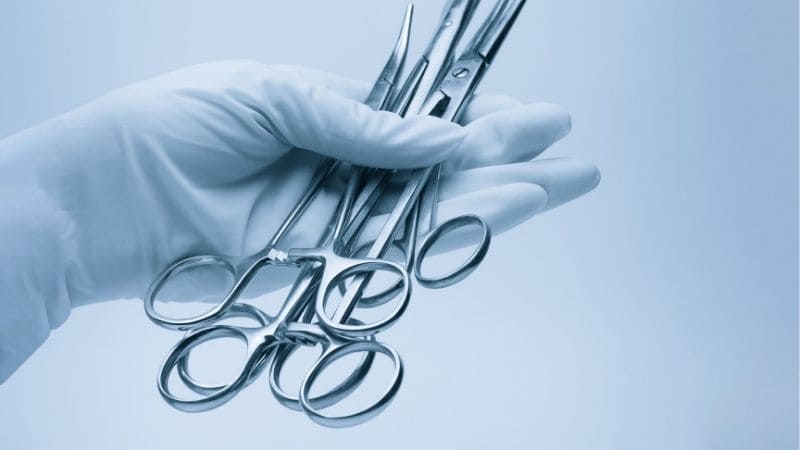
Alloys with high work hardening properties can create difficulties when machining parts; however, if we select speeds and feeds properly, we can avoid tool chatter when manufacturing the hinge component from Nitronic 60. As a result, we efficiently manufactured all of the components.
Tight Tolerances for Surgical-Grade Components
It is important that we used alloys that maintain their properties through heat treatment and sterilization in order to guarantee that we meet the tight tolerance requirements of these critical features.
Surface Finish Requirements for Biocompatibility
A smooth surface is necessary for biocompatibility due to its ability to reduce friction and allow for easier cleaning. By using the proper alloys, we were able to create smooth-surfaced moving components such as pivots and load-bearing components without employing any type of polishing operation.
What is Nitronic 60 Stainless Steel?

Nitronic 60 is a unique stainless steel alloy that is frequently used for components subjected to continuous friction. In most designs, we look to Nitronic when there is sliding, rotating, or repeated use of metallic components against one another.
In regard to surgical instruments, this material is used in areas where the components need to function smoothly over time without sticking or jamming. It is also a superior material to use in applications where long-term dependability is more important than maximum strength.
Key Properties of Nitronic 60
Now, let’s look at some of the key properties of nitronic 60 stainless steel:
- The wear and anti-galling resistance of Nitronic 60 is simply fantastic due to its anti-galling composition. An example is that it can withstand sliding contact loads of more than 50,000 psi, compared to other common 300-series stainless steels for metal-to-metal wear.
- In friction environments, nitronic 60 has corrosion resistance similar to that of ASTM A240 type 304 stainless steel, except that it can withstand repeated sterilization cycles (autoclave).
- It has moderate strength, high toughness, a yield strength of 45 to 55 ksi (310 to 380 MPa), and ultimate tensile strength of 100 to 110 ksi (690 to 760 MPa), offering the very best balance of wear resistance for moving parts.
Why Nitronic 60 is Used in Surgical Instruments
Nitronic 60 is our preferred material when designing surgical parts that must move smoothly over time. It is particularly well-suited for applications that need several points of contact with metals, such as hinges and moving parts.
Using this grade of steel, we can make precisely CNC-machined parts with surfaces that will work dependably throughout many cycles of operation.
CNC Machining Considerations for Nitronic 60

As we machine Nitronic 60, there are some key factors we take into account to ensure the quality of the part being produced:
Work hardening characteristics: Nitronic 60 has a tendency to work-harden quite quickly, which makes it necessary to ensure that the tools used will not become excessively worn out.
Speed and feed rates: The speed at which the material is cut and the feed rate should remain low as well as constant in order to minimize the chance of overheating or damaging the overall quality of the part being produced.
Tooling strategy: Sharp tools will help achieve proper surfaces for surgeries, so the tooling is also very important.
What is 17-4 PH Stainless Steel?

17-4 PH stainless steel is a type of precipitation-hardening stainless steel that has been widely used in the medical device industry. It has earned widespread use due to its ability to remain precise in its shape through complex CNC machining processes and because it provides uniform properties from one manufacturing lot to another.
Surgical devices are frequently made from 17-4 PH stainless steel because of the predictable manner in which they can be processed according to the heat treatment processes, allowing designers the freedom to create devices that must have very tight tolerances.
Key Properties of 17-4 PH Stainless Steel
Now, let’s look at the key technical properties of 17-4 PH stainless steel:
- 17-4 PH typically achieves yield strengths of 170 to 190 ksi (1170 to 1310 MPa) and ultimate tensile values of 190 to 210 ksi (1310 to 1450 MPa). 17-4 PH is ideal for applications with high structural loads, such as installing surgical tools (e.g., handles, drivers, and more).
- 17-4 PH exhibits minimal distortion during and after the heat-treatment aging process. Parts manufactured from 17-4 PH can typically be precision CNC machined to within ±0.0005 inches (±0.012 mm).
- 304 stainless steel and 17-4 PH have similar levels of corrosion resistance, enabling 17-4 PH to be reliably used in repetitive autoclave sterilization cycles and for extended periods in common medical cleaning chemicals.
- 17-4 PH maintains its elastic properties primarily due to its hardness, which typically ranges from 38 to 44 HRC (H900 condition). It is important that components continue to maintain their mechanical properties even after extended cyclic loading.
- 17-4 PH stainless steel has superior machinability in the solution-annealed state compared to many stainless steels, enabling consistent surface finishes and high dimensional accuracy in both simple precision components and complex surgical components during and after machining operations.
Why 17-4 PH is Common in Surgical Instruments
For precise structural parts of surgical instruments, we usually consider 17-4 PH material first. This is because of the predictable behavior of the material during machining operations, which helps us hold tight tolerances on complex parts.
This helps us achieve the reliability of parts like load-bearing handles, screwdrivers, and orthopedic fixtures through multiple cycles of operation. In other words, we are sure that the parts will function perfectly in the way we want them to.
CNC Machining Considerations for 17-4 PH Stainless Steel

When machining 17-4 PH material, precision and predictability are critical:
Machining in solution annealed condition: The part will be machined prior to any heat treatment to allow for easier machining.
Heat treatment after machining: Aging of the material is performed after machining to improve material strength.
Dimensional control: After the heat treatment, the tolerances will be tight; this allows applications that require great precision for surgical instruments.
Nitronic 60 vs 17-4 PH Stainless: Key Differences

Wear Resistance and Galling Behavior
Nitronic 60 outperforms 17-4 PH stainless steel in terms of anti-galling and anti-wear properties; hence, it is recommended for any sliding or moving parts. 17-4 PH stainless steel may experience galling and may require a finish, whether a coating or a lubricant, to protect the surfaces of its components and reduce movement between surfaces.
Strength and Hardness
When it comes to strength and hardness, 17-4 PH stainless steel is certainly superior to Nitronic 60. In the H900 heat-treated condition, it typically provides yield strengths of 170 to 190 ksi and hardness of 38 to 44 HRC, making it able to withstand bending and repeated torque. Nitronic 60 is much softer, typically with yield strengths of 45 to 55 ksi and hardness of 95 to 105 HRB.
Corrosion Resistance in Medical Environments
Both materials exhibit good corrosion resistance, but they behave differently when exposed to friction. Nitronic 60 performs better for sliding applications, ensuring smooth operation even after repeated sterilizations.
Machinability in CNC Production
CNC machining of 17-4 PH stainless steel is regarded as an easier material to machine than Nitronic 60 because it is solution annealed and so more quickly prepared for machining, resulting in a more predictable product.
On the other side, the increased complexity of milling Nitronic 60 is due to its work-hardening properties, making CNC machining a more sophisticated procedure than 17-4 PH stainless steel.
Cost and Availability
Nitronic 60 is more expensive and less readily available than 17-4 PH Stainless Steel. In a typical CNC machining project, a Nitronic 60 Round Bar costs $12 to $18 per kg, depending on bar size. In contrast, 17-4 PH Stainless Steel bars range from $6 to $10 per kg, depending on their size and whether they are annealed or heat-treated.
Additionally, 17-4 PH Stainless Steel is more readily available in a greater variety of bar sizes and lengths, making it more accessible. Thus, Nitronic 60 is typically chosen when galling resistance is required, whereas 17-4 PH Stainless Steel is more cost-effective and readily available.
Nitronic 60 vs 17-4 PH Stainless: Performance in High-Wear Surgical Instruments

Choosing the right steel for high-wear surgical instruments, nitronic 60 vs 17-4 ph stainless, is heavily influenced by the expected performance of the instruments during actual surgical procedures.
Instruments with Moving Parts
In our recent project on precision forceps, Nitronic 60 performed well in instruments where friction and movement are constant. The material performed well, allowing smooth movement of the instrument’s hinges even after hundreds of cycles without binding or slowing down the procedure.
Load-Bearing Surgical Tools
In instruments that bear a load or transfer a torque, 17-4 PH is more appropriate for bone drivers. In our project on orthopedic screws, 17-4 PH performed well in ensuring that the instruments did not flex or bend even when they bore a load.
Repeated Sterilization Impact
Both alloys perform well in repeated sterilization procedures, but they perform this function in different ways. While Nitronic 60 maintains movement, 17-4 PH maintains exact dimensions.
When to Choose Nitronic 60 for High-Wear Instruments
Best Use Cases
We generally prefer to use Nitronic 60 when the instrument function depends on the smoothness of repetitive movements rather than on supporting a structure’s weight. In this regard, the most appropriate uses are in surgical instruments with sliding or rotational relationships; for example, hinge-type joints, clamp-type pivots, or locking surfaces.
Instruments that are designed to be repeatedly assembled and disassembled will also benefit from a high level of resistance to wear over time
Limitations to Consider
Although Nitronic 60 provides smooth movement between moving components, it is not one of our primary choices for use in instruments designed to support structural weight. The machining of an instrument may be more difficult and will require set-ups that are longer to control surface finishes and limit the possibility of work hardening.
When to Choose 17-4 PH Stainless for High-Wear Surgical Instruments
Best Use Cases
When the importance of the components is placed on continued consistent performance over time, as opposed to performance whilst actively in motion, this is where 17-4 PH provides the most reliability to the user.
Limitations to Consider
There are also limitations to consider with this material, wherein the repeated use of metals against one another may require additional coatings or lubrication to be applied. For components with motion, the designer must address friction, which can cause wear, or avoid potential unintentional adhesion.
Can You Combine Both Materials in One High-Wear Surgical Instrument?

Yes, it’s absolutely possible to use both materials in one high-wear instrument, and it’s often the more effective approach. Rather than trying to make one material serve two purposes, each material can be utilized where it’s best suited.
Hybrid Design Approach
Nitronic 60 performs exceptionally well in sliding or moving areas, such as pivot pins, locking mechanisms, or high-friction contact surfaces. These tend to be the first areas on the instrument to wear. Using Nitronic 60 in these areas will help prevent galling and ensure smooth operation.
17-4 PH, on the other hand, performs exceptionally well in the structural areas of the instrument. It’s stronger and stiffer, making it ideal for the handle, arms, or main body of the instrument, where stability is critical.
Benefits in Surgical Instrument Design
This approach allows for the best overall performance without adding unnecessary design complexities. The end result is an instrument that will remain strong, resist wear, and operate more reliably over its life.
Conclusion
The choice between Nitronic 60 vs 17-4 PH isn’t based on the relative strength of the materials. Rather, it’s based on the performance characteristics of the surgical instrument you need. Nitronic 60 performs best in moving areas where wear and galling are problems. 17-4 PH performs best where strength, stability, and tolerance are critical.
If you’re designing a high-wear surgical instrument, we can help you choose the right material and machine it accurately. Contact MedCNCParts today.


